
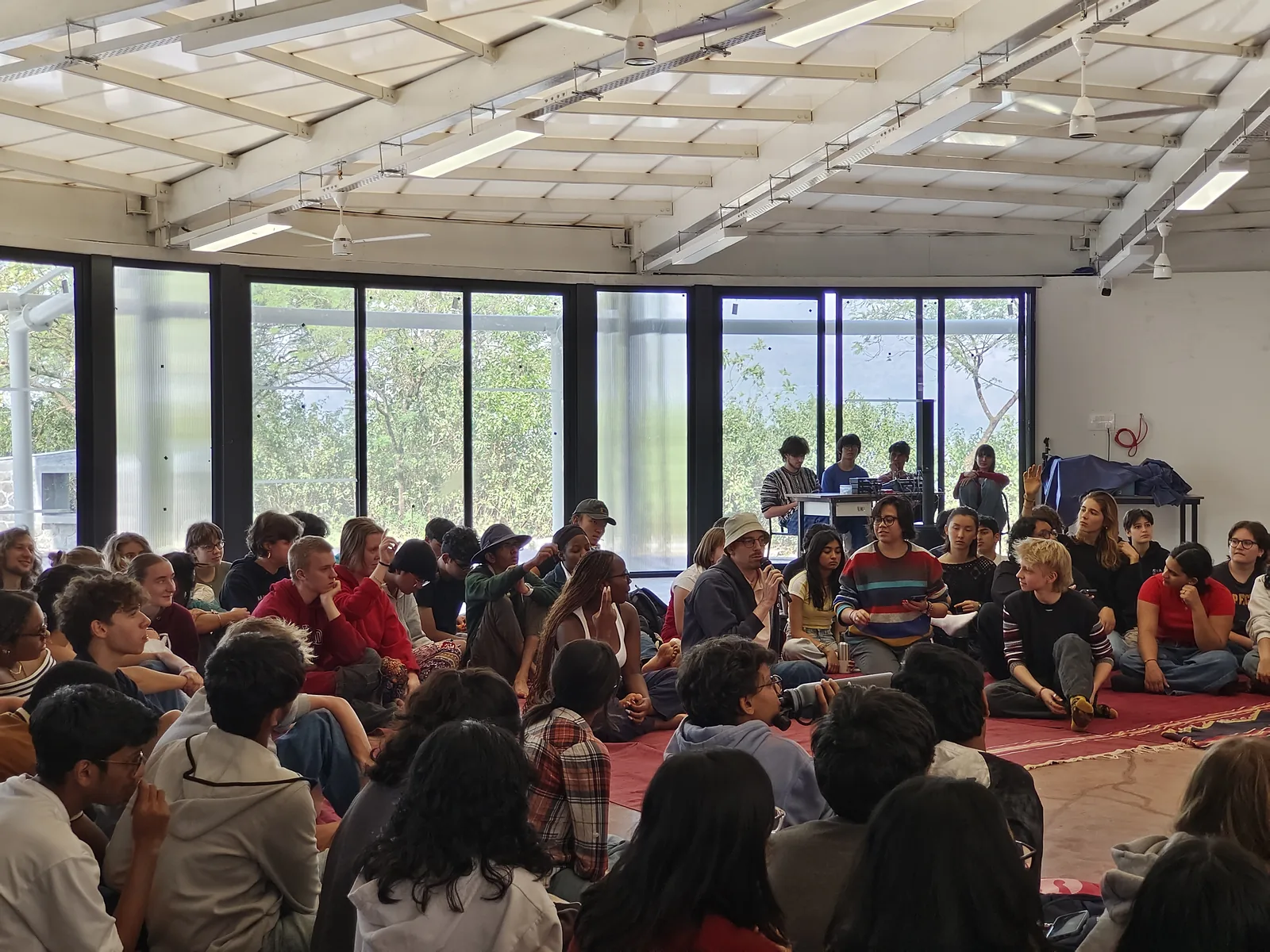
At UWC Mahindra (MUWCI), education doesn't stop at the classroom door. Every week, students set aside their regular timetable to take part in MUWCI CORE — our mission-driven learning programme designed to help students understand, question, and take action on the real-world challenges shaping their generation.
What is MUWCI Core?
MUWCI Core is a weekly session built around short, focused electives that run for three to five weeks at a time. Rather than following a fixed syllabus, each course is designed around a single theme — peace, sustainability, digital literacy, social impact, culture, or leadership — and taught by someone with deep, often first-hand, expertise in that field.
Courses are delivered on campus, online, or in a hybrid format, and are led by a mix of UWC alumni, MUWCI teachers, and visiting guest experts: social entrepreneurs, ecologists, artists, researchers, and practitioners from across India and around the world. What connects them all is a shared commitment to experiential learning — students don't just discuss ideas; they map systems, visit farms and villages, draft policy documents, write leadership manifestos, and build their own responses to the problems they study.
By grounding learning in real-world application, MUWCI Core equips students with the tools, perspective, and drive to become active changemakers in a complex world.
Read the full brochure
Learn moreThis Year's Core Courses
Semester 1
Environment & Sustainability in the Western Ghats
Mandatory · On-site · Taught by Ashwin Paranjape
An introduction to the ecology of the Kolvan and Mulshi valleys — home to MUWCI itself — and one of the world's global biodiversity hotspots. Students learn to run a rapid sustainability audit of the MUWCI campus, and a limited group visits Gorus Organic Farm to see low-impact, water-conscious forest farming in practice.
PSHE & Community Living
Mandatory · On-site · Taught by Muskaan
A mandatory course covering health, wellbeing, and community life at MUWCI.
Celebrating Diversity
Mandatory · On-site · Taught by the MUWCI ARDEI team
Led by MUWCI's student-and-faculty Anti-Racism, Diversity, Equity and Inclusion (ARDEI) team, this course unpacks what it really means to "celebrate difference" — across culture, cognition, physical ability, and politics — and asks whether diversity is always straightforwardly a good thing. Students finish by proposing concrete ways to celebrate the diversity already present on campus.
Waste NOT
On-site · Taught by Amita Deshpande
An experiential sustainability course built around the principles of Refuse, Reduce, Reuse, Repair, Repurpose, Recycle, and Upcycle. Students explore circular design thinking and spend an immersive day at reCharkha's village unit, following the journey of waste from collection to transformation and meeting the artisan communities behind it.
Critical Intimacy
Hybrid · Taught by Stephanie Guarachi
Drawing on Gayatri Spivak's concept of "critical intimacy" — the ability to critique the systems we love and belong to — this course examines the relationship between wealth creation and labour exploitation in the hospitality, outdoor, and experiential education industries, using postcolonial and labour studies frameworks and comparative company case studies.
Semester 2
Leadership and Wellbeing
Online · Taught by Dr. Emily Wassell
Grounded in the science of wellbeing and mindful communication, this course asks: how do I become the kind of leader who creates peace — in myself, my relationships, and the world? Students close the course by writing their own Leadership Manifesto.
Responsible AI for the Planet, Communities and Ourselves
Hybrid · Taught by Roberto Pitea
An exploration of what artificial intelligence means for the planet and global societies, and how it can be used responsibly at a local level. Students put theory into practice by drafting a Responsible AI policy document for MUWCI.
Systems Thinking
Hybrid · Taught by Aparna Bhasin
A practical introduction to systems thinking as a tool for understanding complex, interconnected problems, using hands-on mapping and real-life case studies drawn from across India.
Many Indias
Hybrid · Taught by Usha Rajaram and Cyrus Vakil
Led by two of MUWCI's longest-serving former faculty, this course explores India's extraordinary diversity — across politics, film, caste, class, gender, marriage, language, and food — using clips from Bollywood as a recurring thread.
Bridging Wisdom and Education
Hybrid · Taught by the Faculty of Drepung Gomang University
A course exploring Buddhist thought and Tibetan tradition.
Music & Borders of Bengal
Hybrid · Taught by Moushumi Bhowmik
Bengal has been fractured many times by partition, war, and social division — yet its people share a deep sense of unity. Through folk songs, field recordings, and storytelling, this course explores how music can bridge the divides left behind by politics.
Many Ways to be Human
Online · Taught by Svet Peace (Kanstantsin Tsiarokhin and Amir Bergen)
Run in partnership with the Svet Peace Project, this course uses Socratic seminars built around short texts — literary, philosophical, and artistic — to build comfort with disagreement, patience with difficult ideas, and genuine curiosity about how people from different backgrounds see the world.
Why It Matters
MUWCI Core reflects something central to the UWC mission: that education should prepare young people not just to succeed within existing systems, but to question and reshape them. By learning directly from practitioners — farmers, social entrepreneurs, data scientists, musicians, former diplomats, and community organisers — MUWCI students graduate with more than knowledge. They graduate with practice: the practice of asking hard questions, sitting with complexity, and building real solutions alongside the people who live with these challenges every day.
Yes. Depending on the course, MUWCI Core sessions can be held on campus, online, or in a hybrid format.